Economy Financial centre
Banking supervision, a Swiss history written by scandals
Three years after the collapse of Credit Suisse, the Federal Council wants to give Finma the power to impose fines. The history of supervision shows rules almost always adopted after crises, often at the expense of public finances.
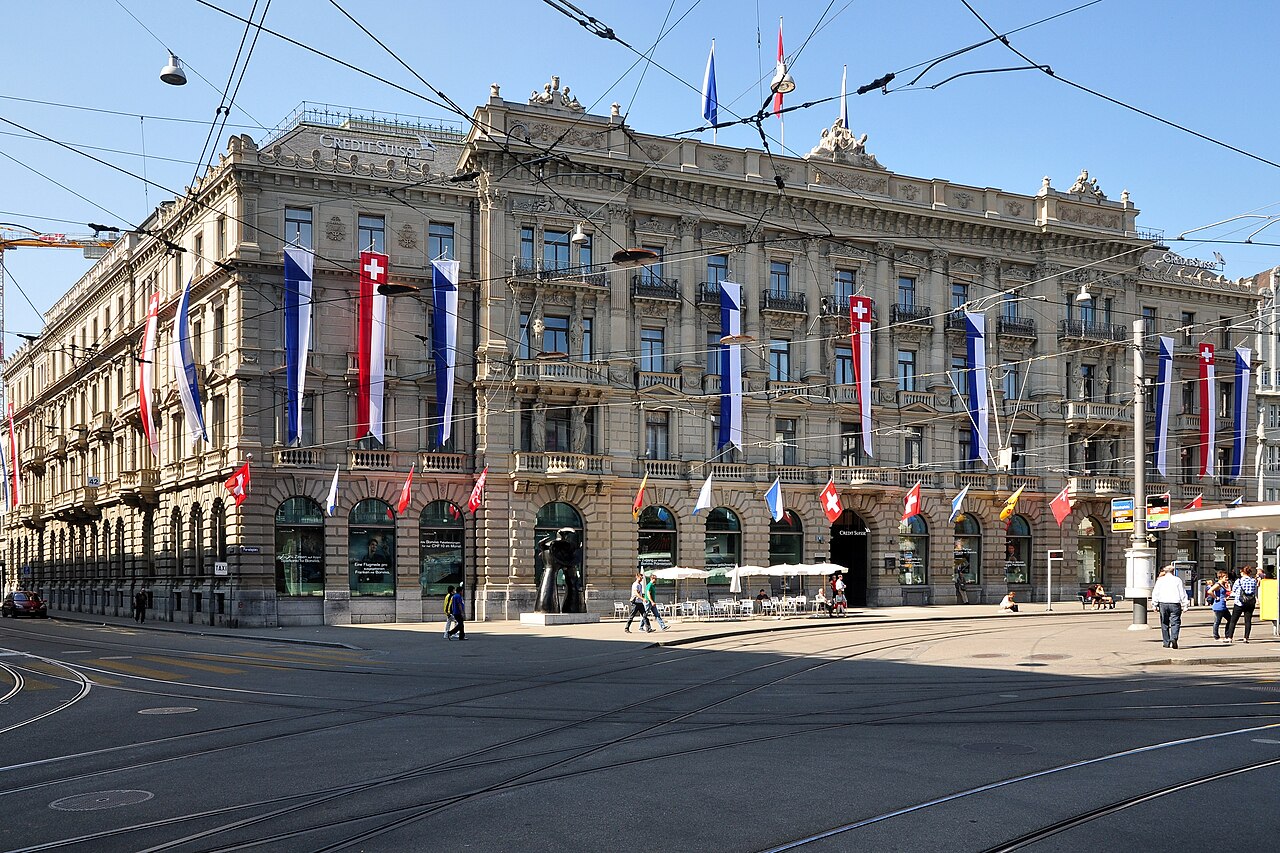
The Federal Council intends to give new powers to the Swiss Financial Market Supervisory Authority: Finma should be able to impose fines and publish the names of non-compliant banks. The reform comes three years after the collapse of Credit Suisse, but an opposition front is already forming in Parliament. History helps to understand what is at stake: in Switzerland, state regulation of the sector was long controversial, and controls have been tightened almost exclusively in the wake of crises.
A first draft of a federal law dates back to 1916, but it sat unused until the 1930s. It took the crisis of the Banque de Genève in 1931 and that of the Swiss Volksbank in 1933, propped up by the state with 100 million francs, for the federal banking law to come into force on 1 March 1935. Its implementation fell to the Federal Banking Commission, made up of five members.
On 4 June 1965 the Commission’s president, Thurgau-born Max Hommel, was dismissed without notice: at his fiduciary office in Bern he advised, for 2’000 francs a month, two companies of the Spanish financier Julio Muñoz, who managed the European investments of the fortune of Dominican dictator Rafael Trujillo. When banks in St. Gallen and Geneva, infiltrated by Muñoz’s front men, granted large unsecured loans, Hommel turned a blind eye. The loans were never repaid and the two institutions failed. Hommel never had to answer in court, and the only legislative consequence was a more precise authorisation requirement for foreign-controlled banks.
From Chiasso to Credit Suisse
The most sensational case struck Italian-speaking Switzerland. In April 1977 it emerged that Credit Suisse’s Chiasso branch had for fifteen years funnelled funds of Italian clients, hidden from the taxman, into a shell company in Liechtenstein — a bank within the bank that accumulated bad loans and speculation. Some 2.2 billion francs passed through it and the loss reached 1.4 billion: the costliest scandal up to that point. In the night of 26 April, the National Bank, together with Swiss Bank Corporation and Union Bank of Switzerland, promised support of up to 3 billion, which was never used. The outcome was a due diligence convention: self-regulation, not law.
When the Social Democratic Party tried the legislative route with an initiative against tax evasion and capital flight, the people rejected it in May 1984 with 73% voting no. Finance minister Willi Ritschard had summed up the mood by declaring that banking secrecy was as untouchable as a nun.
The turning point came with the funds of potentates. In 1986 the Federal Council froze the assets of Philippine president Ferdinand Marcos. In 1999, 660 million dollars belonging to Nigerian dictator Sani Abacha were blocked, and the Commission named all 19 banks involved. With the case of former Peruvian president Alberto Fujimori and his intelligence chief Vladimiro Montesinos, the authority removed a bank executive for the first time.
In 2009, the merger of the Commission with two other authorities gave birth to Finma. The year before, UBS had come close to bankruptcy and been rescued through a partial, temporary nationalisation and a bad bank financed by the National Bank. The too-big-to-fail rules drawn up after that crisis were supposed to prevent new public interventions, but at their first test, in spring 2023, they were not applied: under international pressure, the Federal Council, the National Bank and Finma orchestrated the takeover of Credit Suisse by UBS.
The historical record also shows that the influence of the financial lobby has often ended up weakening controls. For the legislator, the question is twofold: will fines make supervision more effective, or will they translate into new bureaucracy? And will they be enough to prevent the next rescue from once again landing on the public’s bill?
Comments
There are no comments yet. Yours can be the first voice.